Immigration Compliance: What Employers Need to Know Now

Immigration Compliance: What Employers Need to Know Now
Immigration compliance remains a critical responsibility for U.S. employers, particularly as the regulatory landscape continues to evolve. Beyond ensuring proper documentation through Form I-9s, businesses must be prepared for potential audits, agency visits, and ongoing changes to visa programs.
Recent H-1B Program Updates: What’s Changing and Why It Matters
While the H-1B visa is one of several pathways for employing foreign talent in the U.S., it’s not among the most commonly used options for many international businesses. Still, the recent policy changes announced by President Trump are worth noting, as they reflect a broader tightening of U.S. immigration policy and may influence future visa categories.
The H-1B program, commonly used by large technology and consulting firms to employ highly skilled foreign workers, has been significantly affected by a September 2025 proclamation that increases costs and limits access for certain employers.
Here’s a snapshot of what changed:
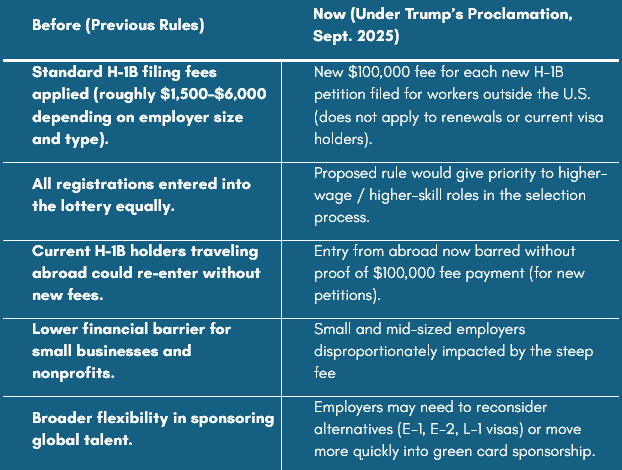
These updates are largely aimed at reshaping how foreign labor is accessed by U.S. employers and are unlikely to directly affect companies using PEO or EOR support as there are more appropriate visas (such as the treaty visas based on trade or investment or intra-company transfer visas) mentioned below. However, they highlight the importance of understanding available visa options when expanding teams across borders.
Common Visa Options for International Teams
For many globally expanding organizations, other visa categories are more practical and widely used than H-1B. These include:
- E-1 Visa: Available for companies with significant trade between their home country and the US. At least 50% of the company must be owned by nationals of the same country as the applicant, and at least 50% of the company’s international trade must be with the US.
- E-2 Visa: For investors from treaty countries who are making a substantial investment in a U.S. business. Commonly used by entrepreneurs or companies establishing a U.S. presence.
- L-1 Visas: For executives, managers, or specialized knowledge employees transferring from a foreign branch or affiliate to a related U.S. entity. Frequently used by growing international companies.
Each of these categories serves different business needs and can support long-term U.S. growth strategies in ways that are often more practical for globally scaling organizations.
Want to learn more? For practical insights on choosing the right Visa for your business, check out our blog article ‘Which U.S. Work Visa Should Your Startup Choose’.
ICE Enforcement and I-9Compliance
Meanwhile, U.S. Immigration and Customs Enforcement (ICE) continues to prioritize workplace enforcement. ICE visits can come in the form of a Notice of Inspection (NOI), a targeted investigation of specific employees, or a broader enforcement action.
Employers should remain proactive by:
- Conducting internal audits of I-9 forms to confirm accuracy and completion.
- Training HR, reception, and security staff on what to do in the event of an ICE visit.
- Partnering with legal counsel to draft a workplace preparedness plan that outlines how to respond before, during, and after an ICE interaction.
- Establishing clear communication protocols so managers and employees know their rights and responsibilities.
A Practical Resource for Employers
To support our clients, we’ve compiled a detailed guide on Preparing for an ICE Workplace Visit which was created from several reputable compliance resources. This resource outlines step-by-step actions, from conducting documentation audits to developing a preparedness plan with counsel, and provides a checklist for what to do if ICE agents arrive at your workplace. We strongly encourage employers to review this guide and integrate its recommendations into your compliance strategy.
The Bottom Line
Immigration compliance isn’t just about avoiding penalties, it’s about protecting your business, your people, and your reputation. Even if your organization doesn’t rely on H-1B visas, it’s important to stay informed about broader immigration policy shifts. With the right preparation, you can confidently navigate changes to visa programs and unexpected agency visits while keeping your employees and staff safe and prepared.